From Spreadsheets to WhatsApp: How We Cut Admin Work by 70% with AI Workflows
See how organisations can move from spreadsheets to WhatsApp workflows, cut admin work by 70%, and what that means for your small business or community group.
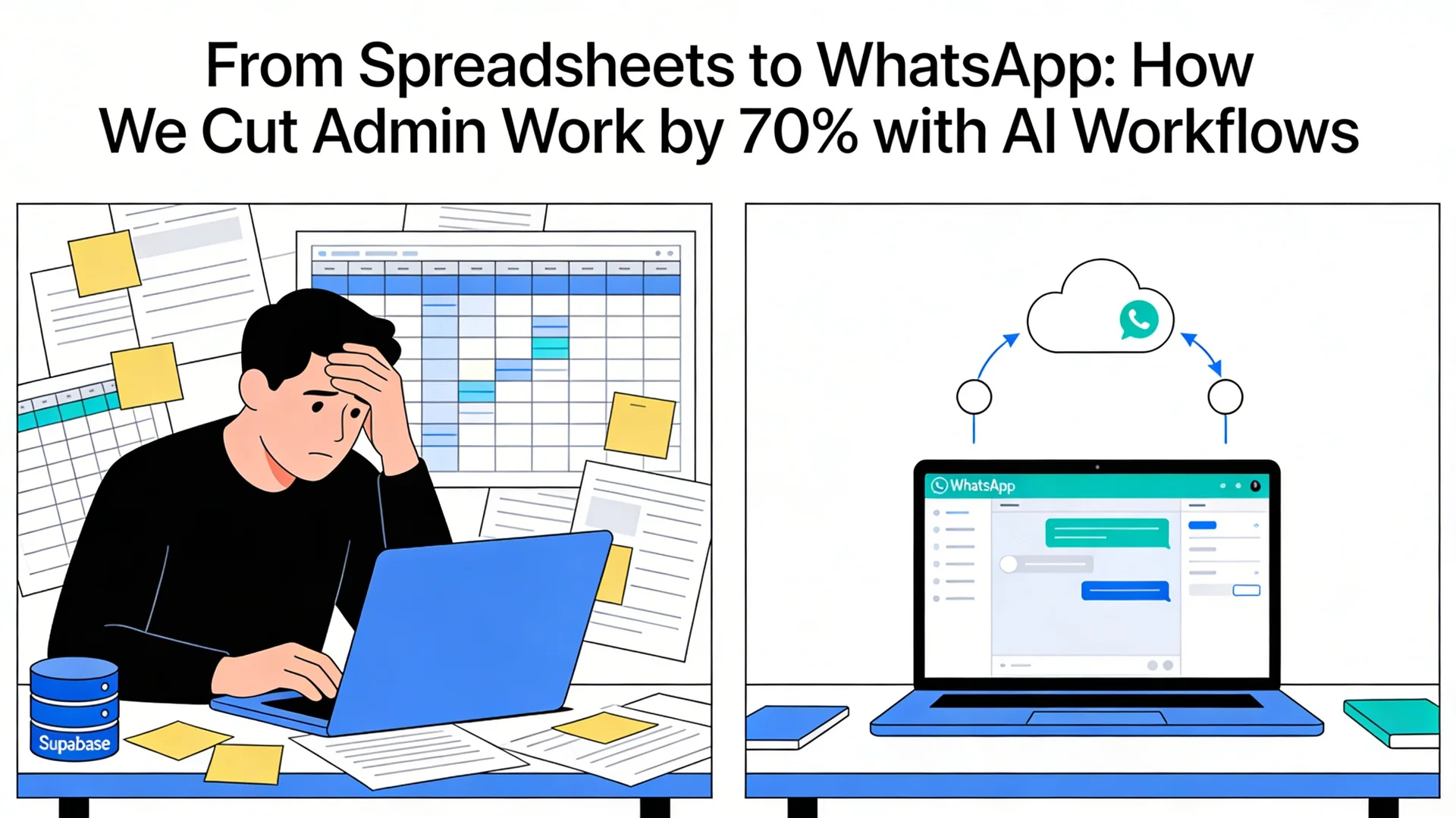
Many small businesses and community organisations still run their admin with spreadsheets, shared inboxes, and late-night messaging.
In this case study, we show how moving from scattered admin to AI-driven WhatsApp workflows, backed by Supabase and Edge Functions, can cut manual work by around 70% and make operations easier to run.
For local teams in places like Darwin, where people often juggle FIFO roles, family commitments, and seasonal event loads, this shift can be the difference between “just coping” and running a reliable, scalable operation.
They need systems that feel natural to customers and members, don't depend on a single “super admin”, and can be maintained without a full-time developer.
Quick Problem / Solution Snapshot
| Area | Before (Spreadsheets & Chats) | After (WhatsApp + Automation) |
|---|---|---|
| Membership/clients | Manual reminders, manual status updates | Automated reminders, live status checks via WhatsApp |
| Bookings/events | Forms, chats, and paper lists in different places | Single WhatsApp entry point, all data stored in one system |
| Payments | Bank transfers checked by hand | Linked payment flows, automatic confirmation and record updates |
| Common queries | Staff checking spreadsheets for each question | AI assistant reading live data and replying in seconds |
| Team workload | Nights and weekends spent copying data around | Focus on high-value work, not low-value admin tasks |
Why WhatsApp Admin Workflows Matter in 2026
Most customers, patients, members, and volunteers already use WhatsApp every day.
When you connect WhatsApp Business API to a proper backend like Supabase, it becomes a front door for your admin workflows instead of another inbox to clean up.
For small organisations and service businesses, that means:
- Faster replies without adding headcount.
- Less time reconciling spreadsheets and bank transfers.
- Better experience for people who prefer messaging over email or phone.
In 2026, AI assistants and cloud tools have matured enough that this kind of workflow automation is realistic for clinics, gyms, trades, and community groups, not just large enterprises.
The Starting Point: Typical Admin Pain
Before automation, we usually see a similar pattern across organisations:
- Member or client lists spread across spreadsheets, cloud drives, and personal notes.
- Customers or members messaging staff directly about renewals, bookings, and questions.
- Payments arriving via bank transfer, card links, or cash, with staff checking and updating records by hand.
- Bookings and RSVPs living in forms, chats, and sometimes paper lists at the front desk or door.
Most of this work happens outside normal hours.
If a key staff member or volunteer is away, sick, or on shift, important information can sit in their phone or personal files.
The shared goal is simple:
- Reduce manual admin by at least half.
- Make it easy for customers and members to do everything from their phone.
- Keep the system simple enough that new staff or volunteers can use it without a developer.
The Solution: WhatsApp, Supabase, Edge Functions, and AI
At a high level, we build a membership and communication system that uses WhatsApp at the front and modern, cloud-based tools at the back.
Core components:
- WhatsApp Business API as the main communication channel for customers and members.
- Supabase as the central database for memberships, bookings, and payments.
- Supabase Edge Functions as the server-side logic layer that connects WhatsApp, Supabase data, and payment tools.
- An AI assistant that understands natural language questions and triggers the right workflows.
You can think of the flow like this:
- A person sends a WhatsApp message.
- The message hits a webhook, which calls a Supabase Edge Function.
- The Edge Function reads or writes data in Supabase, applies business rules, and decides what to do next.
- The workflow either returns a direct answer via WhatsApp or hands off to a human for complex cases.
This pattern works for:
- Membership-based organisations.
- Appointment-based clinics and practices.
- Class or session-based gyms and studios.
- Lead-driven trades and service businesses.
Visual Logic Without Custom Backends
A key design goal is “no custom backend to maintain”.
Supabase and Edge Functions let us keep logic close to your data, without building and hosting a separate application server.
Each workflow feels like a clear, visual map in design, even though it runs as code in Edge Functions:
- Trigger: WhatsApp message received with a certain keyword or detected intent.
- Logic: Edge Function checks Supabase for membership status, booking availability, or payment status.
- Decisions: choose paths such as “send renewal link”, “confirm active booking”, or “add to waitlist”.
- Actions: send WhatsApp messages, update records, or notify a human admin.
This approach gives you:
- A single source of truth in Supabase for all key records.
- Predictable, testable logic in Edge Functions, which is easier to version and deploy.
- A path to more advanced workflows over time, without changing the core stack.
How the AI Assistant Fits In
Traditional auto replies only handle strict keywords and templates.
Modern AI assistants can understand real, conversational messages, even when people don't use exact phrases.
Typical messages include:
- “Have I paid for this year?”
- “Can you renew our family membership?”
- “Can I book a spot at the 6pm class?”
- “Do you have any availability next Thursday?”
- “We need a quote for this job, what is the process?”
The AI layer helps by:
- Detecting intent, such as renewal, booking, quote request, or general information.
- Looking up the correct record or open slot in Supabase through Edge Functions.
- Generating a clear reply that follows your rules and tone.
- Escalating to a human when the request is unclear or sensitive.
Instead of replacing staff, the AI handles repeatable questions so humans can focus on complex cases, customer service, and decision-making.
Key Impact: What Changes After Automation
Organisations that adopt this pattern usually see a similar set of outcomes:
- Manual admin effort for membership, bookings, and basic queries drops by about 70%.
- Data accuracy improves because WhatsApp, payments, and Supabase all stay in sync.
- Response times drop from hours or days to near-instant replies for common questions.
- Staff experience improves, with fewer late-night “spreadsheet and bank statement” sessions.
- New staff and volunteers onboard faster because processes are now explicit, automated, and documented.
For small teams that rely on flexible rosters, part-time roles, or volunteers, this makes the admin side of the organisation far more sustainable.
Deep Dive: Three High-Impact Workflows
1. Membership and Subscription Renewals
Before:
- Spreadsheets and ad-hoc notes track who has paid.
- Staff manually send reminders and chase responses.
After:
- WhatsApp sends friendly, pre-approved reminder messages before expiry dates.
- Members can reply to renew, ask questions, or get a payment link.
- When a payment succeeds, a Supabase Edge Function updates the member record and sends a confirmation message.
- The AI assistant answers questions like “what type of membership do I have?” or “when does mine expire?”.
Result: fewer manual checks, clearer records, and a smoother renewal experience.
2. Bookings, Events, and Session Management
Before:
- Bookings come through forms, calls, messages, and sometimes walk-ins.
- Capacity and waitlists are managed manually.
After:
- Each service or event has a simple entry keyword, such as “book physio”, “join class”, or “register event”.
- WhatsApp collects key details (names, date, time, number of attendees) and stores them in Supabase.
- Edge Functions check availability, confirm bookings, and send clear WhatsApp confirmations.
- Optional: reminder messages go out before the booking, plus follow-ups for feedback or reviews.
Result: one live bookings table, fewer no-shows, and less manual chasing.
3. Payment Confirmation and Admin Alerts
Before:
- Staff check bank or payment provider dashboards and update records by hand.
- Important changes get buried in group chats or personal threads.
After:
- Payment providers send webhooks that trigger Supabase Edge Functions.
- Edge Functions update payment status in Supabase and send WhatsApp confirmations automatically.
- High-value payments or exceptions trigger internal WhatsApp alerts to admins.
- Manual overrides or special cases are logged in Supabase so there is always a clear history.
Result: less time spent reconciling payments and a clearer view of cash flow and commitments.
Who This Approach Works For
Although each organisation is different, the underlying pattern is the same.
Here is how different types of organisations can benefit.
Community and cultural groups
- Manage memberships, event registrations, and donations.
- Keep volunteers in the loop without forcing them into complex systems.
Clinics and allied health
- Automate appointment confirmations, reminders, and basic intake over WhatsApp.
- Gather key information before the visit and reduce no-shows.
Gyms, studios, and sports clubs
- Handle membership renewals, class bookings, and waitlists.
- Send last-minute changes or updates quickly to affected members.
Trades and service businesses
- Use an AI assistant to ask for photos, job details, and location.
- Qualify leads before you pick up the phone, so staff focus on real opportunities.
If your customers, patients, or members are already contacting you in WhatsApp, you can use the same building blocks: WhatsApp Business API, Supabase as your database, and Edge Functions as your logic layer.
Common Pitfalls and How to Avoid Them
When moving to WhatsApp-based admin automation, we often see similar mistakes.
Common pitfalls:
- Treating WhatsApp as a stand-alone tool, not connected to a central database.
- Over-automating and making it hard to reach a real person.
- Ignoring consent, opt-out, and basic privacy expectations.
- Building fragile, one-off integrations that no one can maintain later.
Better practices:
- Use Supabase as your single source of truth so WhatsApp and your “official” records always match.
- Design clear handover paths from AI to humans for edge cases.
- Make opt-out and message frequency clear from day one.
- Keep core logic in Edge Functions with version control, rather than scattered scripts.
Our Implementation Approach at Hrishi Digital
We use a repeatable approach that fits both small businesses and community organisations.
Process mapping
We review how you currently handle memberships, bookings, payments, and common queries, including all the spreadsheet and “side-channel” steps.Workflow design
We design WhatsApp-first workflows that map to your real processes and model them against a Supabase schema.Supabase and Edge Functions setup
We set up Supabase tables for members, bookings, payments, and logs, and implement business logic in Edge Functions.AI assistant configuration
We configure an AI assistant with your FAQs, policies, and tone so it can answer common questions and trigger the correct Edge Functions.Integration, testing, and training
We connect payment providers, test end-to-end with real scenarios, and train your team to monitor and adjust workflows over time.
This gives you a stable core built on Supabase and Edge Functions, with WhatsApp Business API and AI providing a user-friendly front-end for customers and staff.
Is Your Organisation Ready for WhatsApp Admin Automation?
You are likely ready to take the next step if:
- You answer the same questions every week in WhatsApp.
- Admin staff or volunteers spend too much time updating spreadsheets and chasing payments.
- You worry that key knowledge sits in one or two people’s heads or phones.
You don't need to automate everything at once. Most of the benefit comes from getting one or two high-impact workflows right, such as renewals, bookings, or payment confirmations.
If you'd like to explore what this could look like for your organisation, we can review your current admin workflows and design a staged WhatsApp automation plan using Supabase and Edge Functions, tailored to your team, budget, and level of technical comfort.
Book a free 30-minute call to talk through your workflows. No sales deck, no obligation.
Hrishi Digital Solutions
Expert digital solutions provider specialising in modern web development, automation, and workflow optimisation for Australian small businesses and community organisations.
Contact Us →