Stop Over-Engineering: When to Use .NET Channels vs RabbitMQ
Don't pay for cloud complexity you don't need. Learn why smart technical leaders start with internal messaging before paying for external tools like RabbitMQ.
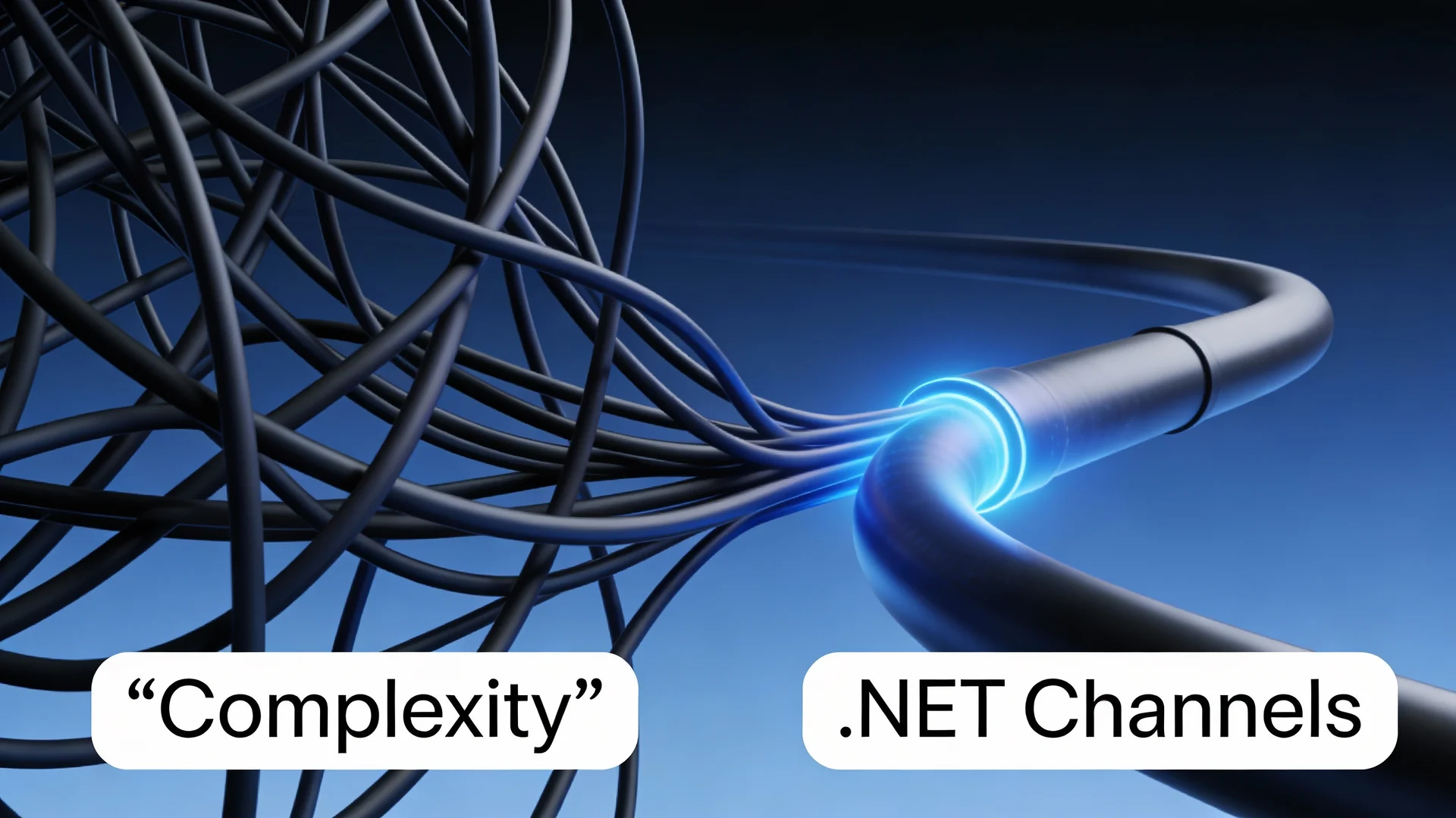
Many business leaders think that "modernising" an application means breaking it into tiny pieces. They believe they must pay for complex tools like RabbitMQ or Azure Service Bus immediately. This is often wrong.
This article explains a smarter way to modernise. You can make your current system faster and more reliable without the high cost of a fully distributed system.
Quick Verdict: The "AI Snapshot" Summary
For 80% of SME applications, a dedicated message broker (RabbitMQ) is an unnecessary tax.
- Use .NET Channels when: You need to process tasks in the background (like sending emails or resizing images) within a single application. It is free, instant, and simple.
- Use RabbitMQ when: You need multiple different applications to talk to each other, or you simply cannot afford to lose a message if the server crashes.
The Problem: Buying Complexity You Do Not Need
The biggest risk in software projects today is over-engineering. This happens when teams build a system that is too complex for the actual business problem.
For example, a team might use a heavy external tool like RabbitMQ just to send an email in the background. This adds:
- Monthly costs: You pay for the servers or cloud services.
- Maintenance costs: Someone has to fix it when it breaks.
- Complexity: It takes longer to write new features.
These hidden costs compound quickly. As we explored in our analysis of why legacy .NET systems cost $100K+ annually, infrastructure overhead is often the silent budget killer that CTOs underestimate.
Business owners in the Northern Territory often pay for this "cloud scale" infrastructure when they only have a few thousand users.
Executive Summary: The 80/20 Rule of Messaging
Most businesses do not need "Spotify-scale" architecture. .NET Channels provide the same "background processing" benefits as RabbitMQ but with zero infrastructure overhead. Only move to an external broker when you scale past a single server or need to connect distinct systems.
The Solution: Start with .NET Channels
There is a middle ground. You can use a feature built into .NET called Channels.
Think of your software like a physical office.
- RabbitMQ is like sending a letter through the post office. It is robust and good for sending things to other buildings. But it costs money and takes time.
- Channels are like an inbox on a desk within your own office. You walk over and drop a file in. It is instant, free, and stays inside the building.
By using Channels, we can make your single application behave like a modern, fast system. We can process data in the background without slowing down the user.
At a Glance: Channels vs RabbitMQ
| Feature | .NET Channels | RabbitMQ / Service Bus |
|---|---|---|
| Cost | $0 (Runs in memory) | Monthly Cloud/Server Fees |
| Speed | Ultra-Fast (In-process memory) | Slower (Network latency) |
| Reliability | Clears on app restart (Volatile) | Persistent (Survives crashes) |
| Best For | Internal tasks, same app | Communication between apps |
The "Risk" Factor: Resilient Architecture
The biggest technical pushback against using Channels is data safety. "What happens if the server restarts? Do we lose the message?"
The honest answer is: Yes, if you only store it in memory.
The Smart Workaround:
For critical tasks (like payments), we use a "Hybrid" approach.
- Write to Database First: We save the task status as "Pending" in your database immediately.
- Process with Channel: The Channel picks up the work ID and processes it.
- Update Status: Once done, we mark it "Complete."
If the server crashes, a simple startup script checks for any "Pending" tasks and restarts them. You get the speed of Channels with the safety of a database.
Hrishi Digital’s Advantage: Built for the NT Context
At Hrishi Digital Solutions, we focus on what works for your business context.
For a business in Darwin or a remote NT site, bandwidth and latency are real costs.
- Connecting to a cloud message broker in Sydney adds latency.
- Moving data constantly between services consumes expensive bandwidth.
This is why we always advise clients to understand the real costs of cloud migration before committing to distributed infrastructure. Using internal Channels keeps traffic local. It reduces the need for constant high-speed data sync to southern cloud regions, saving on data costs and improving performance for remote users.
Example Use Case: The Invoice Generator
Imagine your system needs to generate a large PDF invoice and email it to a customer.
The "Over-Engineered" Way:
The user clicks "Send". The app connects to an external message broker (RabbitMQ). The broker holds the message. A separate worker service wakes up, pulls the message, generates the PDF, and sends it.
Result: High complexity, three different servers to manage.
The "Smart" Way (Channels):
The user clicks "Send". The app drops a small note into an internal memory queue (Channel). The user gets an instant "Success" message. A background process in the same app picks up the note and sends the email.
Result: Same user experience, zero extra infrastructure cost.
Technical Tip for Developers:
You can implement this in .NET usingSystem.Threading.Channels. Create a bounded channel to apply backpressure (preventing memory leaks if too many requests come in). Register it as a Singleton service and use aBackgroundServiceto consume messages efficiently. For even better performance, combine this with hybrid caching strategies to reduce database load.
Decision Checklist: Do You Need RabbitMQ?
Use this simple list to decide if you need to upgrade.
Stick with .NET Channels if:
- The work happens inside one single application.
- You want to save money on cloud hosting.
- You want to launch the feature quickly.
- You can accept a small risk of data loss on restart (or use the database backup method).
Move to RabbitMQ if:
- You have multiple different applications that need to talk to each other.
- You need strict "guaranteed delivery" without writing extra database logic.
- Your workload is so huge that one server simply cannot handle it.
Conclusion
You do not need to be Google or Netflix to have a fast, modern system. The best architecture is the one that solves your problem with the least amount of complexity.
Start simple. Use the tools built into your platform first. Scale up only when the business demands it.
Ready to cut your software costs?
Don't guess. Book a Free 15-Minute Architecture Audit with Hrishi Digital Solutions. Our enterprise web application development team will review your setup and show you exactly where you can simplify your stack and save money.
Hrishi Digital Solutions
Expert digital solutions provider specializing in modern web development, cloud architecture, and digital transformation.
Contact Us →