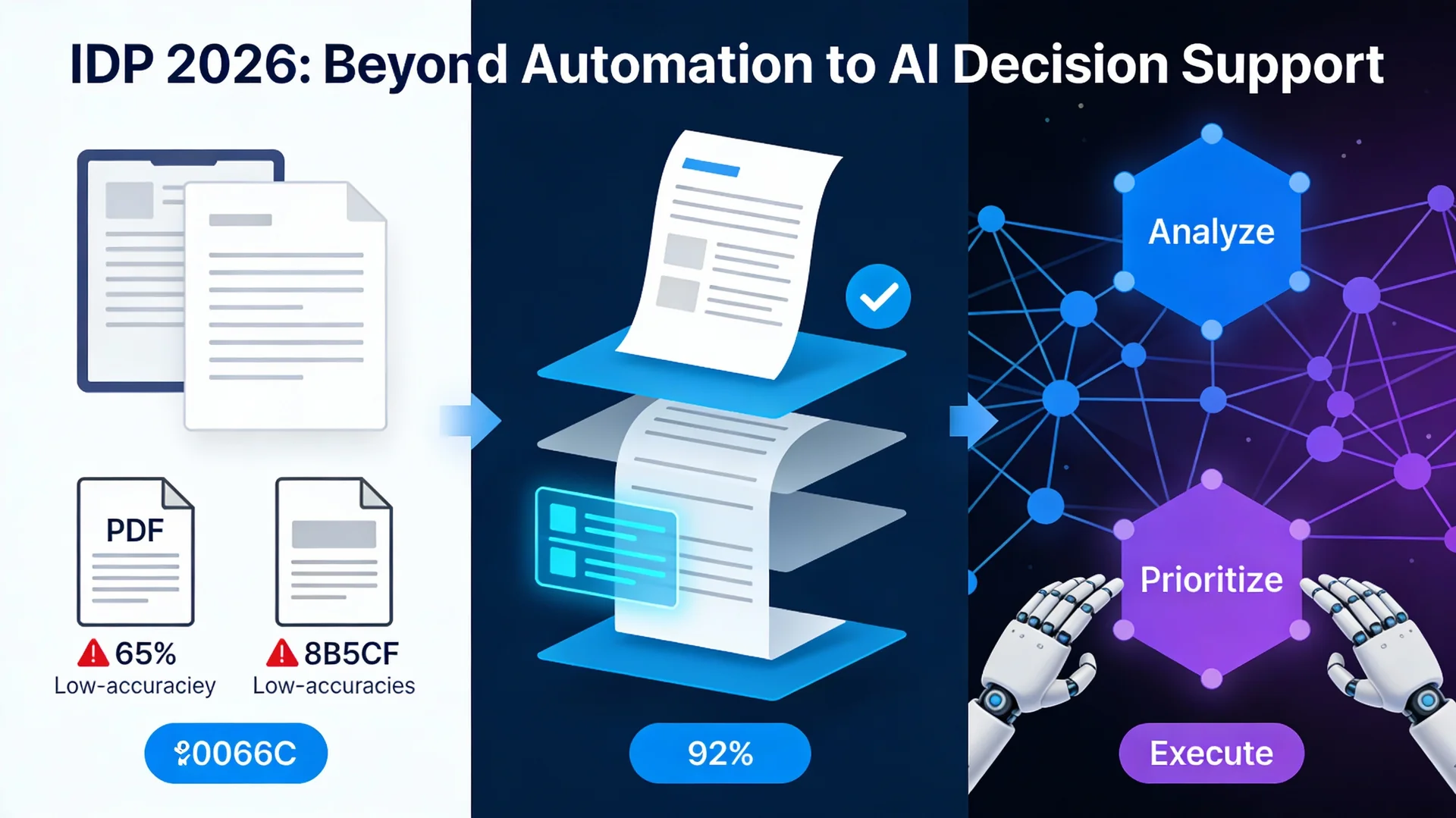
IDP 2026: Beyond Automation to AI Decision Support
65% of firms moving to reasoning based IDP. Learn how to shift from cost-cutting to fraud detection and 98% accuracy. Get the 2026 ROI roadmap.
Document processing has become one of the most transformative areas of enterprise AI. What started as simple optical character recognition (OCR) has evolved into intelligent reasoning systems that don't just read documents they understand risk, detect fraud, and recommend decisions. In 2026, organizations that still view document processing as purely a cost-cutting tool are missing the strategic advantage.
This article walks you through the evolution of intelligent document processing (IDP), shows why 65% of large organizations are already implementing reasoning-based IDP, and reveals the critical mistake most teams make when adopting this technology.
Key Insights: The 2026 Shift in Document Processing
Before diving deeper, here's what you need to know:
Information Gain: 2026 marks a fundamental shift from viewing IDP as a cost-reduction tool to recognizing it as a decision-support system. Organizations that treat IDP as merely automation are leaving 60-70% of value on the table.
Agentic Workflows: Modern IDP systems now operate as autonomous agents. They don't just extract data; they can validate inconsistencies, flag fraud, route exceptions, and even autonomously communicate with vendors when discrepancies are found. For a broader view of how agentic AI is transforming enterprise operations, see our guide on autonomous AI agents and agentic intelligence.
Real ROI: 70-80% time reduction, 89% accuracy improvement, and 3-6 month payback are achievable. But the strategic wins (fraud prevention, risk detection, compliance assurance) deliver 3-5x more value than labor savings alone.
Why This Matters Now: In 2026, your competitors are already moving. 65% of large organizations are implementing or scaling reasoning-based IDP. Waiting another year means accepting higher fraud risk, slower decision-making, and competitive disadvantage.
The True Cost of Manual Document Processing
Before understanding why IDP matters, let's quantify the pain.
Finance teams processing invoices, purchase orders, and payment records manually are losing time at an alarming rate. Organizations report that document bottlenecks are costing 500+ hours per month per team hours spent on data entry, verification, routing, and exception handling. That's roughly equivalent to 2-3 full-time employees doing nothing but moving documents between systems and people.
The financial impact is clear: spreadsheets, email chains, and PDF reviews slow down every critical process. Accounts payable cycles stretch across weeks. Legal teams spend months reviewing contract variations. Government agencies process permits at a fraction of required capacity. Healthcare organizations struggle with claim processing delays. Insurance companies face exponential fraud losses because human review is too slow to catch patterns.
In 2025, organizations approached this problem by asking: "How do we automate this away and cut costs?" That was the right question then. In 2026, the question has shifted to: "How do we use this data to detect fraud, flag risk, and support better decisions?"
The Evolution: OCR to Intelligent Reasoning
Understanding where we've come from helps explain where we are now. The journey from basic scanning to autonomous reasoning systems happened faster than most organizations realize.
| Feature | Gen 1: OCR (1990s-2010s) | Gen 2: Template-Based (2010s-Early 2020s) | Gen 3: Modern IDP (2020-2025) | Gen 4: Reasoning & Agents (2026) |
|---|---|---|---|---|
| Technology | Basic image-to-text scanning | Rule-based systems and regex | Deep learning, NLP, computer vision | LLMs, reasoning engines, autonomous agents |
| Accuracy | 70-80% (requires human verification) | 85-90% (works for standardized docs) | 95-98% (exceeds manual) | 99%+ with contextual understanding |
| Capabilities | Digitize documents | Extract structured data | Classify, validate, detect exceptions | Make autonomous decisions, communicate with systems |
| Primary Goal | Document storage | Process efficiency | Cost reduction + automation | Decision support + fraud prevention + risk management |
| Value Driver | Reduces paper storage | Reduces manual entry | Reduces staff overhead | Creates competitive advantage |
Generation 1: Optical Character Recognition (OCR) - 1990s to 2010s
Early OCR systems scanned paper documents and attempted to extract text. They worked reasonably well for clean, standardized documents but failed catastrophically with poor quality scans, handwriting, or unusual layouts. Accuracy hovered around 70-80%, requiring human verification on nearly everything. Value was limited: you could digitize documents, but you still needed people to interpret them.
Generation 2: Automated Data Extraction - 2010s to Early 2020s
Rule-based systems and basic machine learning added structure. Templates could specify "find the invoice number in this zone" or "extract line items from tables." Accuracy improved to 85-90%, but systems were rigid. Change the document layout by 2%, and the extraction failed. These systems worked for high-volume, standardized documents (invoices from a single vendor) but struggled with variation.
Generation 3: Intelligent Document Processing (IDP) - 2020s
Deep learning and computer vision transformed the landscape. Modern IDP systems combine optical character recognition, computer vision, natural language processing, and large language models to achieve 98% accuracy higher than skilled manual workers. More importantly, these systems understand context. An IDP system doesn't just extract "amount: $50,000" from an invoice; it understands whether that amount is unusual for the vendor, whether the PO matches, and whether payment terms have changed.
Generation 4: Reasoning and Agentic Workflows - 2026
The latest generation adds a reasoning layer and autonomous agency. Instead of just extracting and validating, IDP systems now anticipate needs, recommend actions, and execute decisions. An agentic IDP system can autonomously email a vendor when an invoice discrepancy is detected. It can flag a compliance issue and route it to the right department. It can learn from past decisions and improve its own thresholds. This is where the strategic value and competitive advantage unlocks.
The Technology Stack Behind Modern IDP
Modern intelligent document processing isn't a single tool it's a stacked architecture. Understanding this stack explains why accuracy has reached 98-99% and why these systems increasingly act as autonomous agents.
Optical Character Recognition (OCR): Converts scanned images and PDFs into machine-readable text. Modern OCR handles handwriting, multiple languages, rotated documents, and complex layouts with 97%+ accuracy. The foundation is solid.
Computer Vision: Analyzes document layout, identifies regions (header, body, tables, signatures), and segments content by type. Computer vision understands spatial relationships it knows that "Invoice #12345" is a header field, not a line item. This contextual understanding is critical.
Natural Language Processing (NLP): Interprets meaning, extracts named entities (vendor names, dates, amounts), and understands relationships between data points. NLP catches when "net 30" is payment terms, not a quantity. It resolves ambiguity in ways rule-based systems cannot.
Large Language Models (LLMs): Provide contextual reasoning and can handle novel document types without retraining. An LLM can read an entire contract, understand obligations, identify risk clauses, flag deviations from a standard template, and explain its reasoning all without being explicitly programmed to do so. When combined with vector databases for semantic search, these systems can retrieve and reason over massive document collections.
Reasoning Engines & Agentic Frameworks: The latest layer enables systems to make decisions based on multiple inputs, take autonomous action, and learn from outcomes. A reasoning agent can detect a payment discrepancy, check supplier history, identify that the discrepancy is within acceptable variance, and approve payment all without human intervention.
Together, these components achieve 98% accuracy compared to 90% manual accuracy. Human reviewers miss details, get tired, and inconsistently apply rules. AI systems never miss a pattern once trained on examples.
Real-World Impact: The Numbers That Matter
Theory is one thing; results are another. Organizations implementing modern IDP report:
70-80% Time Reduction: Accounts payable processes that took weeks now close in days. Claims processing that required manual queuing now flows continuously. Legal contract review that took 2 weeks drops to 2 days.
89% Accuracy Improvement: Starting from 90% manual accuracy, moving to 98% IDP accuracy eliminates the bulk of rework and exceptions. Error rates in payment processing, data integrity, and compliance reporting drop dramatically.
3-6 Month ROI: Because the time savings are so significant, most organizations see payback within a quarter or two. A typical finance team processing 50,000+ invoices per year saves $200,000-500,000 annually in labor costs alone. Software and implementation costs typically range from $50,000-200,000, depending on scope.
But here's the critical insight: the cost savings are the easy win. The harder, higher-value win is what happens when you have cleaner, faster, richer data feeding your business decisions. When you prevent fraud instead of detecting it after the fact. When you flag compliance risk before it becomes liability.
What 2026 IDP Can Actually Do
Modern intelligent document processing systems are far more capable than most organizations realize. Here's what's in scope:
Document Classification: Automatically categorize incoming documents (invoice vs. purchase order vs. credit memo vs. statement). This sorting happens in milliseconds, and misclassification rates are under 1%.
Field Extraction and Validation: Pull key data (invoice number, vendor, date, amount, line items) and validate against rules. The system knows that vendor names should match your master vendor list and flags exceptions automatically.
Risk Detection: Identify potential fraud or compliance issues. Duplicate invoices from the same vendor within 30 days. Invoices for unusual amounts compared to historical patterns. Missing required approvals or sign-offs. Amounts that exceed PO values. These patterns are detected automatically, not flagged manually by tired eyes.
Exception Routing: Send only high-risk or unusual documents to humans for review. A typical system processes 85-95% of documents fully automatically and routes 5-15% for exception review. This lets your team focus on judgment calls, not data entry.
Predictive Processing: Anticipate which documents you'll need next. A procurement system can detect when a PO is approaching and proactively prepare for the associated invoice. A healthcare system can predict which claims will require additional documentation and request it upfront. This eliminates delays before they happen.
Agentic Communication: Modern IDP systems can autonomously email suppliers about discrepancies, request missing documentation, or notify stakeholders of issues. The system doesn't wait for human review; it acts based on pre-defined policies and learned patterns.
Industry Applications: Where IDP Delivers Maximum Value
Different sectors are seeing different high-impact use cases:
Accounts Payable (AP): Invoice processing is the bread-and-butter use case. IDP handles 3-way matching (PO, receipt, invoice), validates amounts, and flags discrepancies. Processing costs drop from $10-15 per invoice to under $2. In our work with Australian logistics firms, we've seen fraud detection improve by 340% year-over-year through pattern recognition that human reviewers were missing.
Legal and Contracts: Contract review, risk clause identification, obligation extraction, and renewal alerting. A legal team that reviewed 200 contracts manually per year can now review 2,000. Risk clauses are flagged automatically, and deviations from standard terms are highlighted.
Government and Permits: Permit applications, licensing, and regulatory compliance. Government agencies can process permit applications weeks faster, improving citizen experience and freeing staff for complex cases.
Healthcare and Claims: Insurance claim processing, eligibility verification, and documentation validation. Claims that took 10 days to process now complete in 1-2 days. Fraud indicators are detected in real-time, not after payment.
Insurance and Underwriting: Claims assessment, risk evaluation, and document verification. Underwriters get cleaner data faster, enabling faster quote turnaround and fewer disputes. Agentic systems can request missing documentation autonomously.
Privacy-First AI: Data Residency for Australian Businesses
One critical consideration for Australian organizations: where does your document data live?
Many US-based LLM providers (OpenAI, Anthropic, Cohere) have different data handling policies. For compliance and privacy, Australian organizations should:
- Ensure document data stays within Australian data centers (AWS Sydney, Azure AU regions).
- Use privacy-first models that don't train on your data.
- Implement data residency requirements in vendor contracts.
- Consider hybrid approaches: use local models for sensitive documents, cloud LLMs for general classification.
This isn't a constraint; it's a strategic advantage. Privacy-conscious AI actually builds trust with stakeholders and customers.
The Critical Mistake: Treating IDP as Pure Cost-Cutting
Here's where most organizations go wrong.
Teams approach intelligent document processing as a labor reduction exercise. "We have 5 people processing documents; IDP will let us handle the volume with 1 person." That's true, but it's thinking too small.
The Bigger Mistake: Stopping at cost reduction means you're only capturing 30-40% of the potential value. You're still treating documents as transactional artifacts that need to be processed and filed. You're not using the rich, clean, fast data they contain to detect fraud, flag risk, or support better decisions.
The organizations winning with IDP in 2026 are asking different questions:
- "What fraud are we missing because manual review is too slow?"
- "What payment risks aren't we catching?"
- "How could cleaner data improve our supplier relationship management?"
- "What opportunities are we missing because we can't process documents fast enough to act on them?"
- "Can our IDP system autonomously handle routine vendor communication?"
This shift from cost-cutting to value-creation changes the entire value proposition. Instead of measuring IDP by "how many people we can lay off," measure it by "what new risks we can now detect" and "what business decisions we can now make faster."
The Human Role in 2026: From Data Entry to AI Auditor
One concern organizations have: "If IDP automates document processing, what happens to our team?"
The answer: role transformation, not elimination.
In the 2025 model, staff processed documents. In the 2026 model, staff audit AI decisions.
This is a massive upgrade in work quality. Instead of repetitive data entry, your team:
- Reviews exceptional cases and edge cases (the 5-15% the AI flagged for human judgment).
- Audits AI decisions for bias and accuracy (the "AI Auditor" role).
- Works on supplier relationship management using clean data IDP provided.
- Investigates fraud trends that IDP detected.
- Trains and improves the AI system (feedback loops).
The organizations that win with IDP are those that retrain staff into these higher-value roles. Those that treat IDP as a job-cutting exercise see resistance and poor adoption.
Building Your IDP Strategy: A Three-Phase Approach
If you're considering intelligent document processing for your organization, here's a practical framework:
Phase 1: Assess and Prioritize
Identify your highest-volume, highest-pain document processes. Accounts payable, claims processing, and contract review are usually the top three. Estimate the current cost (staff time, errors, delays) and identify the biggest risk fraud, compliance, speed, or accuracy.
Select one process to pilot. This should be high-volume (to justify the effort) and relatively standardized (to make training easier). Avoid trying to automate "everything" in year one.
Phase 2: Implement and Validate
Deploy IDP software (or engage a partner) to handle the pilot process. Modern platforms like Automation Anywhere, UiPath, or specialized document AI services can be operationalized in 8-12 weeks.
Train the system on 100-200 example documents. Validate accuracy on a test set. Set performance targets: 95%+ accuracy for standard cases, 100% flag rate for exceptions.
Set up human-in-the-loop (HITL) feedback: every exception, every misclassification, every fraud catch trains the system. The AI gets better over time.
Phase 3: Expand and Optimize
Once the pilot is proven (3-6 months), expand to additional document types and processes. Layer in agentic capabilities: autonomous vendor communication, compliance alerting, exception routing.
Integrate IDP with downstream systems so that extracted data flows directly into your ERP, accounting system, or analytics platform. The real value emerges when clean data reaches decision-makers.
Common Pitfalls to Avoid
1. Over-Customizing at the Start
Resist the urge to handle edge cases and exceptions in year one. Implement the core workflow (the 80% of standard documents), automate those well, and then layer in exceptions. This keeps timelines reasonable and costs manageable.
2. Ignoring Data Governance
IDP generates clean, structured data. But if that data isn't properly governed if you don't have consistent master data lists (vendor names, cost codes, approval hierarchies) the benefits degrade. Spend time cleaning your master data before launching.
3. Treating Documents in Isolation
A standalone document processing system has limited value. Wire IDP into your broader business processes. Connect it to your ERP, accounting system, CRM, or analytics platform. The real value emerges when cleaner data flows through your entire operation.
4. Not Planning for Continuous Learning
IDP systems improve with more examples. Set up feedback loops where exceptions and errors feed back into model retraining. A system that's static gets worse over time (as document formats change). One that learns continuously gets better.
5. Underestimating Change Management
Technology implementation is 20% tool, 80% people. Budget time and resources for training, process redesign, and organizational change. The best IDP deployment will fail if staff don't understand the new workflow or resist the change. Frame IDP as "freeing you from data entry so you can do judgment-based work" instead of "replacing you."
The Competitive Advantage: 2026 and Beyond
Organizations that adopt intelligent document processing in 2026 are gaining a strategic advantage that will compound:
Faster Decision-Making: Data that took weeks to process now comes in hours. This speed translates directly to faster decisions approving suppliers, detecting fraud, resolving disputes, processing claims.
Better Risk Management: Fraud detection, compliance flagging, and exception routing are built-in. You're not relying on humans to notice patterns; the system catches them automatically. And with agentic workflows, the system acts on them in real-time.
Improved Customer Experience: In healthcare, insurance, and government, faster document processing means faster outcomes for customers. Claims get paid faster. Permits get approved faster. Treatments begin sooner.
Data-Driven Operations: Clean, structured data from millions of documents becomes fuel for analytics and optimization. You can now ask questions like "What's our true supplier concentration risk?" or "Which claim types have the highest fraud rate?"
Scalability Without Adding Staff: Your finance team can handle 2x invoice volume with minimal additional headcount. Your legal team can review 10x more contracts. This scalability without proportional cost growth is how competitive advantage compounds.
Your Next Step
Intelligent document processing is no longer experimental. It's a mature technology with proven ROI that's reshaping operations across every industry. Agentic workflows are moving from "nice to have" to "table stakes."
The question isn't whether your organization should adopt IDP it's whether you can afford not to in a competitive landscape where speed, accuracy, and risk detection are differentiators.
If you're processing documents manually today, the cost of staying the same is growing every quarter. If you're ready to move beyond cost-cutting and unlock the strategic value in your documents, now is the time to act.
Ready to explore intelligent document processing for your organization? Our experts can assess your document workflows, identify the highest-impact opportunities, and build a realistic roadmap. We've helped finance teams, legal departments, and government agencies achieve 70-80% time reductions and unlock new risk management and decision-support capabilities.
Book a free 30-minute consultation with our IDP specialist to discuss your specific challenges and opportunities. We'll show you exactly where the biggest wins are for your business and how agentic workflows can unlock value beyond simple automation.
Key Takeaways
Remember these core points:
- IDP evolved from OCR extraction to agentic reasoning systems capable of autonomous fraud detection and decision support
- Modern systems achieve 98%+ accuracy (vs. 90% manual) with 70-80% time reduction and 3-6 month ROI
- 65% of large organizations are already implementing reasoning-based IDP; falling behind means losing competitive and fraud-detection advantage
- The 2026 shift is from cost-cutting to strategic value: fraud detection, compliance assurance, risk flagging, and decision support
- Agentic workflows now enable autonomous vendor communication and real-time exception handling
- Privacy-first AI and data residency are critical for Australian organizations
- Human roles shift from data entry to AI auditing and exception handling
- The critical mistake is treating IDP as purely a cost-reduction play and missing the deeper business impact
- Success requires proper change management, data governance, continuous learning, and integration with downstream systems
- The real competitive advantage emerges when clean, fast data flows through your entire operation
Need guidance on your intelligent document processing strategy? Reach out to discuss a pilot program tailored to your highest-impact use cases. Our AI integration and automation services combine technology expertise with industry experience to deliver realistic, measurable results.
Hrishi Digital Solutions
Expert digital solutions provider specializing in intelligent automation, document processing, and AI-driven business optimization.
Contact Us →