Google UCP Explained: The 2026 Guide to AI-Powered Shopping for Your Business
Google's Universal Commerce Protocol (UCP) is here. Learn how to prepare your business for agentic commerce, direct checkout in Gemini, and the end of cart abandonment.
Google just launched something big. On January 11, 2026, at the National Retail Federation Big Show in New York, Google unveiled the Universal Commerce Protocol (UCP). This is not just another tech update. It is a fundamental shift in how AI agents and online businesses connect to enable shopping. If you run an e-commerce business or manage digital transformation, you need to understand what UCP is, why it matters, and how to prepare.
The stakes are high. Retailers who move fast gain competitive advantage. Those who wait risk falling behind as agentic commerce becomes the default way customers research and buy in 2026.
Introduction: The N Times N Problem Google UCP Solves
Shopping behavior has changed dramatically. Customers no longer follow a linear path. They search on Google, ask questions to Gemini, browse on apps, and expect instant checkout. But today, when a customer wants to buy something through an AI agent like Gemini, the experience falls apart. The AI stops. The customer is sent to a different app. They re-enter payment information. The cart gets abandoned.
This friction exists because of what industry experts call the "N times N integration bottleneck." Here is what that means:
You run an online store. Right now, to reach customers through AI agents, you would need to build a custom connection to Google's AI Mode, another to Gemini, another to Amazon's AI Shopping Agent, another to Apple's Siri Commerce, and so on. Each connection is different. Each needs its own engineering work. Each requires separate security and payment handling.
Meanwhile, from the AI platform side, Google needs to build a connection to every retailer. Shopify. Etsy. Target. Wayfair. And hundreds more.
The result is exponential complexity. This is the N times N problem. And it is why conversational shopping today is broken.
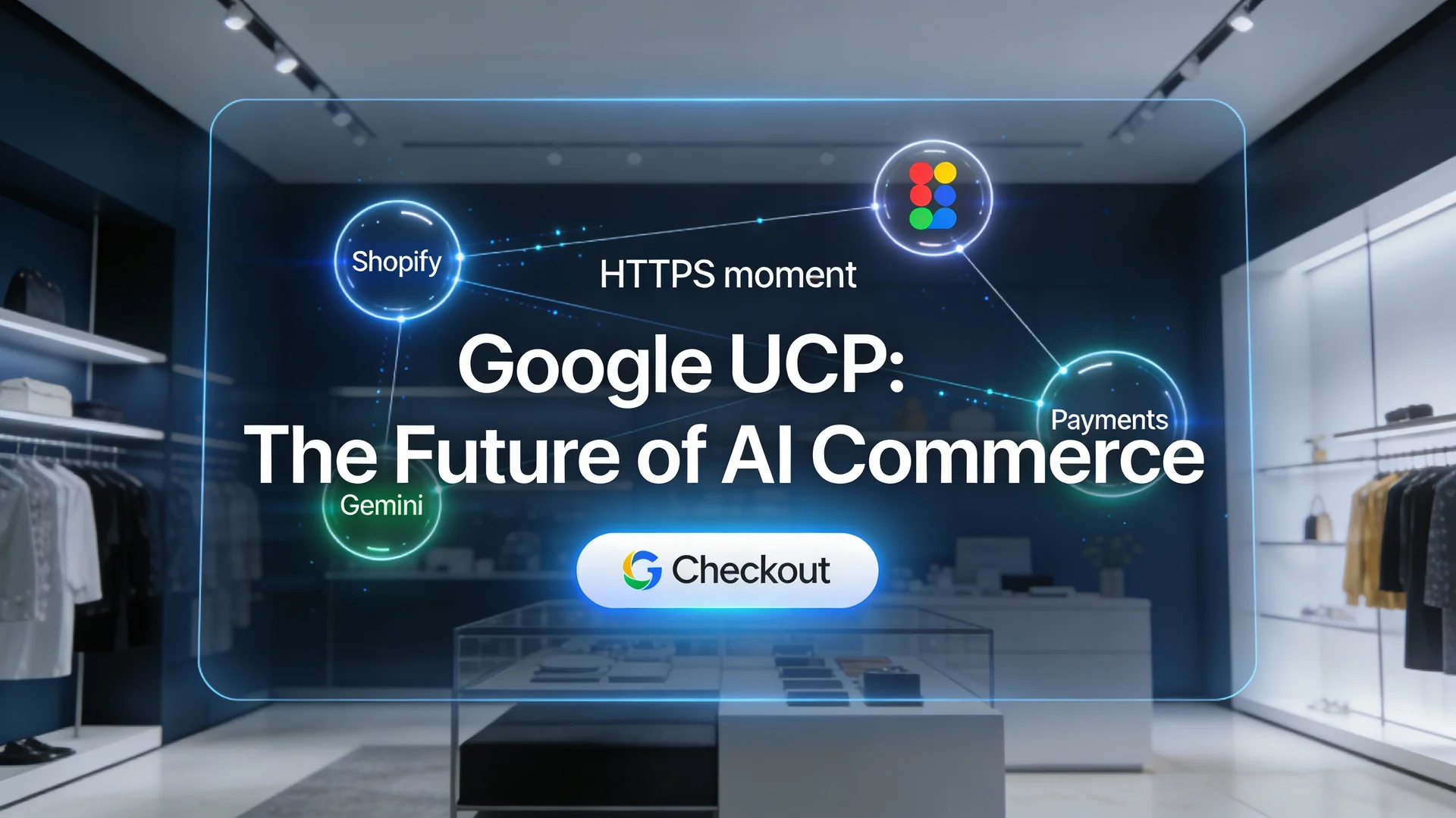
Google UCP fixes this. It is the unified language that all AI agents and all retailers speak. This is what industry observers are calling "the HTTPS moment for retail." Just as HTTPS became the standard for secure web communication, UCP is becoming the standard for secure AI commerce.
Why Agentic AI Shopping Is the Future, Not a Future
Agentic AI is not coming. It is here. People are using AI assistants not just to ask questions but to make decisions and buy things. Google AI Mode lets people ask complex questions directly in search. Gemini helps them research and decide. These are no longer just information tools. They are shopping companions.
The data proves this shift. In 2026, more customers are using AI agents to research and compare products than ever before. Early adoption is concentrated among high-value customers and tech-forward demographics. The customers who use AI shopping agents are the ones willing to spend money.
Retailers who enable seamless checkout in these experiences capture sales that would otherwise be lost.
What Is Google Universal Commerce Protocol (UCP)? Key Features and Benefits
UCP is an open standard built by Google with 20 major retail and payment partners. These include Shopify, Target, Etsy, Wayfair, Best Buy, Walmart, Visa, Stripe, American Express, and Mastercard.
Here is what UCP does:
It sits between consumer AI services (like Google Gemini and AI Mode) and business backend systems. It standardizes everything from product discovery and checkout to order management and post-purchase support. When a customer wants to buy something through an AI agent, UCP handles the entire conversation.
UCP enables real-time inventory checks. It manages dynamic pricing. It processes payments instantly. It keeps the customer inside the AI experience the entire time. No app switching. No re-entering payment details. Just checkout.
The protocol is built with security first. Every payment includes tokenized credentials and cryptographic proof that the customer gave permission. This prevents unauthorized transactions and protects both businesses and customers. The money movement is handled through Google's Agent Payments Protocol (AP2), which is the standard for secure payment handling in agentic systems.
UCP also integrates with existing standards already in development: Model Context Protocol (MCP) and Agent2Agent (A2A). This means UCP is not another isolated system. It is part of a larger ecosystem of AI-powered commerce infrastructure.
How Agentic AI Shopping Works in Practice
Picture this scenario:
A customer uses Google Search and AI Mode to research running shoes. They ask Gemini complex questions about brands, materials, sustainability, and pricing. The AI agent searches across multiple retailers. When they are ready to buy, they do not leave the AI experience. UCP takes over. It checks inventory across retailers in real time. It confirms pricing. It processes payment through Google Pay (with PayPal and other providers coming soon). The customer completes the purchase without leaving the conversational experience.
For the retailer, this is handled through a single UCP integration. You build one connection, not dozens.
But there is more. Google also announced "Direct Offers," which are AI-detected discounts. The AI agent scans your product feed, identifies opportunities, and surfaces dynamic discounts to customers at the exact moment they are considering a purchase. This is personalization at scale.
The Merchant of Record Advantage: Why You Keep Your Customer Relationship
This is critical to understand: with UCP, you remain the Merchant of Record. This is not like marketplace models where Amazon or eBay own the customer relationship. With UCP, the transaction is on your books. The customer data is yours. The repeat purchase opportunity is yours.
This has massive implications for brand loyalty and long-term customer value. When you remain the Merchant of Record through an AI shopping experience, you build a direct relationship with customers. They know they are buying from you, not from an AI platform. You control the brand experience, the follow-up, and the retention strategy.
Retailers who understand this advantage will dominate agentic commerce in 2026.
Common Mistakes Retailers Make with Agentic Commerce (And How UCP Prevents Them)
Many retailers are not ready for agentic commerce. Here are the mistakes we see happening right now:
Mistake 1: Building custom integrations for every AI platform. This wastes engineering resources and creates technical debt. UCP solves this by standardizing the connection layer. Build once, connect to all agents. Your integration cost drops dramatically.
Mistake 2: Ignoring checkout friction in conversational experiences. Some retailers assume AI shopping is just research. But when checkout breaks, the whole experience fails. UCP prioritizes seamless checkout as part of the core protocol. Treat this as non-negotiable.
Mistake 3: Not maintaining real-time inventory and pricing. Conversational AI agents need to give accurate information instantly. If your backend systems cannot provide real-time data, the customer experience suffers. UCP requires this capability built in. If you are still using batch updates or daily feeds, you are behind.
Mistake 4: Treating Merchant Center as an ads tool, not an AI asset. This is the biggest mistake we see. In 2026, your Google Merchant Center feed is not just for ads. It is the brain the AI agent uses to shop. Your feed quality directly impacts how AI agents understand and recommend your products. Google recently released new AI-specific data attributes like product compatibility and multi-modal descriptions. You need to adopt these now.
Mistake 5: Treating agentic AI as a separate channel. UCP is not a bolt-on feature. It is a transformation of how customers interact with your business. Retailers who treat it as secondary will lose to competitors who embrace it fully.
Why Google Merchant Center Is Now Your Most Important Asset
In 2026, your product feed is no longer just an advertising input. It is the foundation of how AI agents understand, evaluate, and recommend your products.
Here is why this matters:
AI agents rely on structured product data to make intelligent recommendations. A product with incomplete data or low-quality attributes is invisible to AI agents. A product with rich, accurate attributes in the right format gets recommended more often.
Google just released new AI-specific attributes for Merchant Center. These include:
Product compatibility data (which products work together, which are alternatives, which complement each other). Multi-modal descriptions (text, images, and video together, not separately). Custom labels for AI agents (how you want your product positioned). Structured reviews and ratings in a format AI agents can parse.
Retailers who optimize their feeds for AI will see dramatic increases in discovery through agentic shopping.
This is not a future priority. This is something you need to start this month.
The Hrishi Digital Framework: Five Steps to UCP Readiness
At Hrishi Digital Solutions, we help businesses modernize for AI-first commerce. Here is our framework for UCP readiness:
Step 1: Audit Your Current Commerce Stack. Do your systems handle real-time inventory? Can your payment processing integrate with tokenized credentials? Are your backend systems API-ready? Many legacy systems cannot handle the speed and security UCP requires. This audit typically reveals 3 to 5 critical gaps.
Step 2: Optimize Your Google Merchant Center Feed. Review your product data quality. Are you using the new AI-specific attributes? Do your descriptions include all the information an AI agent would need to make a recommendation? This is your foundation. Get it right before you integrate UCP.
Step 3: Assess Your Data Architecture. UCP needs clean, accurate product data and pricing information available instantly. If your data is scattered across different systems, consolidate it. This is where cloud platforms like Azure Cosmos DB and Azure SQL Database shine for handling real-time commerce data.
Step 4: Evaluate Payment and Security Infrastructure. UCP requires modern payment processing with tokenized credentials and Agent Payments Protocol support. Your current payment gateway might not support this. Plan the upgrade now. Work with providers who understand AP2 and agentic systems.
Step 5: Plan Your Integration. Will you integrate directly or through a platform like Shopify (which already supports UCP)? Will you use Google's reference implementation for Merchant Center? Build a timeline and assign ownership. Expect 4 to 8 weeks for a complete implementation if your foundation is solid.
Why Timing Matters: The 2026 Competitive Window
UCP is launching immediately. Google has already enabled UCP checkout in AI Mode and Gemini for eligible US Merchant Center businesses. For Australian and APAC businesses, the rollout will accelerate throughout 2026. This is not a future roadmap. The infrastructure is live today.
Retailers who move first gain three significant advantages:
First, they capture early adopters. Customers using AI agents to shop are typically tech-savvy and have higher purchase intent. Early adoption gives you access to this high-value segment before competitors catch up. These are the customers willing to spend money and buy frequently.
Second, they learn faster. Every UCP implementation teaches you something about how customers interact with conversational commerce. This knowledge is invaluable. By 2027, when adoption accelerates and becomes mainstream, you will already understand what works, what does not, and how to optimize.
Third, they build brand authority. Early adopters in agentic commerce become industry leaders. Articles, case studies, and speaking opportunities follow. Your agency or brand becomes known as the expert in AI shopping, not just another e-commerce provider.
The window for early mover advantage is open now. By mid-2026, this advantage closes.
Preparing for APAC Rollout: Why Australian Businesses Have an Edge
For businesses in Australia, Darwin, and across the APAC region, UCP creates a level playing field with global e-commerce giants. You do not need massive engineering teams to compete in AI-powered commerce. You need one solid UCP integration and a high-quality product feed.
Businesses in Australia also benefit from geographic advantages. Your products, inventory, and customer data are already local. When customers in Australia or the broader APAC region use AI agents to shop, they want products that ship locally. When customers in the US use AI agents to shop for Australian products (like specialty goods, regional brands, or unique items), UCP makes this experience seamless.
This is especially valuable for businesses selling to APAC and US markets. By preparing now, you position yourself to capture international demand through AI agents when the APAC rollout accelerates in the second half of 2026.
What Comes Next: The 2026-2027 Roadmap
Google is not stopping with checkout. The roadmap includes:
Advanced product discovery optimization through AI agents. Loyalty rewards integration directly into conversational experiences. Custom shopping experiences tailored to individual customers and their behavior. Expansion beyond Google to other AI platforms that adopt UCP standards. Integration with voice assistants and other conversational interfaces.
More payment providers are coming. Mastercard and American Express are already on board. This means customers will have familiar payment options and options that match their regional preferences.
The protocol will evolve. New features will be added. Early adopters will help shape this evolution and have input on future versions.
Decision Checklist: Is Your Business Ready for UCP in 2026?
Ask yourself these questions honestly:
- Do you sell products online and want to reach customers through AI shopping assistants?
- Is your product data accurate, complete, and available in real time?
- Have you reviewed your Merchant Center feed for AI-specific attributes?
- Can your payment processing handle tokenized credentials and Agent Payments Protocol?
- Is your backend infrastructure API-ready and cloud-enabled?
- Do you have the engineering capacity to integrate new commerce standards?
- Are you tracking customer behavior through conversational interfaces?
If you answered yes to 6 out of 7 questions, UCP is a priority for Q1 2026. If you answered yes to 5 or fewer, you need to address those gaps before moving forward. Start with your Merchant Center feed and data quality.
Take Action Today: Your 2026 Competitive Advantage
The future of retail is conversational. Agentic AI is not a trend. It is a permanent shift in how customers research, decide, and buy. Google UCP is the infrastructure that makes this possible at scale.
The retailers leading in conversational commerce in 2027 are the ones preparing today. They are auditing their systems. They are optimizing their product feeds. They are planning their UCP integrations. They are learning how customers interact with AI shopping agents.
Do not wait for mainstream adoption. Move now. Gain the advantage.
Ready to Lead in Agentic Commerce? Let Hrishi Digital Help
Google UCP represents a massive opportunity for retailers willing to innovate. But integration requires technical expertise, strategic planning, and deep understanding of both commerce and AI systems. That is where Hrishi Digital Solutions comes in.
We help businesses modernize their commerce infrastructure for agentic AI. We audit your systems. We optimize your Merchant Center feed for AI discovery. We plan your UCP integration. We handle the technical implementation. And we optimize your performance for conversational commerce.
If you want to lead in agentic commerce in 2026, let us help you get there.
Book a free 30-minute consultation to review your commerce readiness and discuss your UCP strategy. Let us audit your Merchant Center feed and identify quick wins. Or download our "Agentic Commerce Readiness Checklist" to see exactly where your business stands today.
The time to move is now. The advantage goes to those who act this quarter.
Contact us today.
Hrishi Digital Solutions
Expert digital solutions provider specializing in AI commerce, cloud architecture, and digital transformation.
Contact Us →