.NET 10: Unleashing Next-Generation Performance and Enterprise Features
Discover .NET 10's revolutionary performance improvements, post-quantum cryptography, and advanced JIT optimizations driving the future of enterprise development.
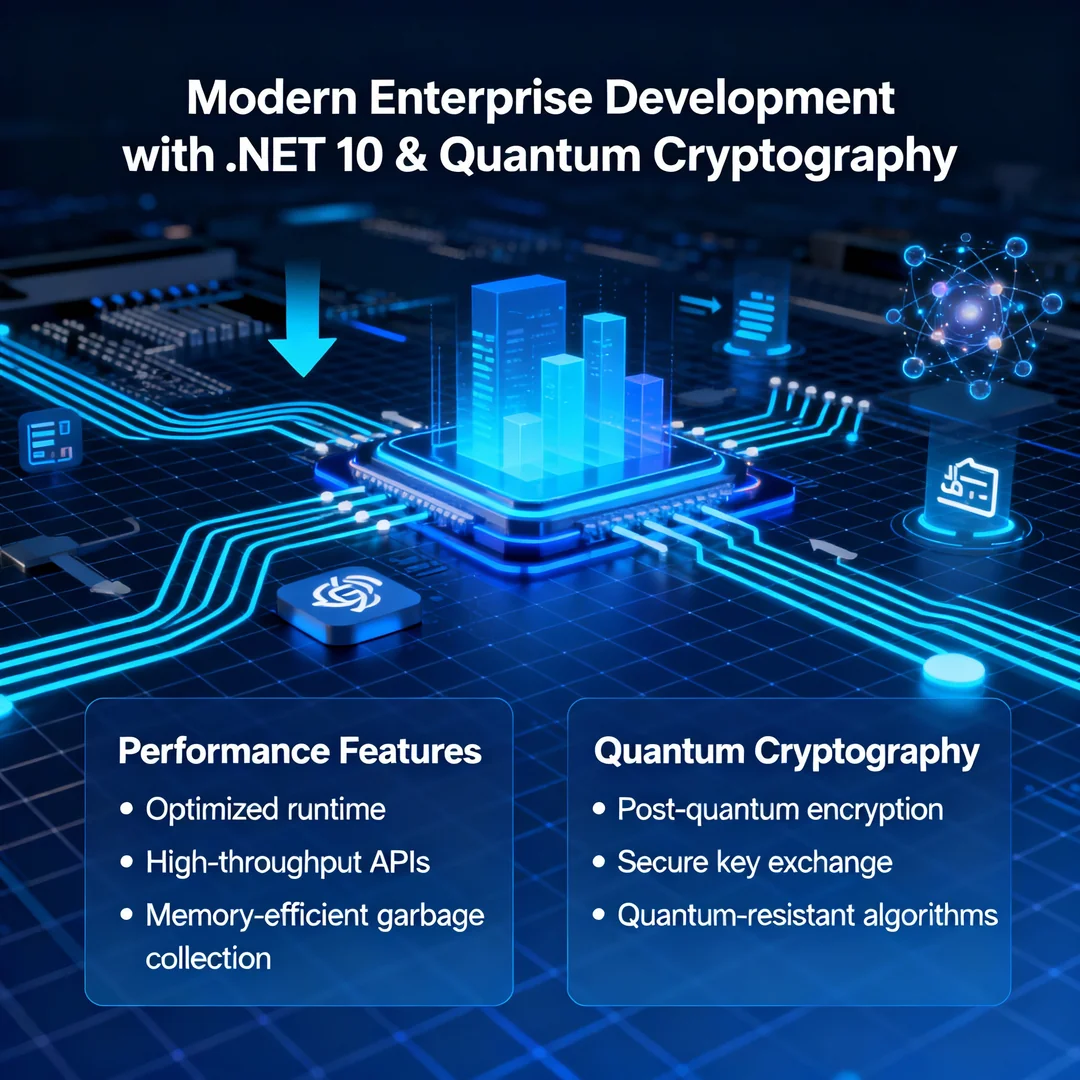
With the release of .NET 10 as a long-term support (LTS) release in November 2025, Microsoft has delivered a platform that fundamentally transforms enterprise application development. This isn't merely an incremental update-it's a quantum leap in performance, security, and developer productivity. As we navigate an increasingly complex technology landscape, .NET 10 emerges as a critical advancement for organizations seeking to build scalable, secure, and high-performance applications that stand the test of time.
Introduction: The .NET 10 Revolution
The journey to .NET 10 represents Microsoft's unwavering commitment to pushing the boundaries of runtime performance and developer experience. For enterprises operating in Australia and globally, this LTS release carries significant implications. With three years of guaranteed support, organizations can confidently invest in platform modernization knowing they have a stable, continuously improved foundation. For those still on legacy frameworks, now is the time to plan your ASP.NET Core migration.
What makes .NET 10 particularly compelling is the breadth of improvements across the entire stack. From the Just-In-Time (JIT) compiler generating increasingly optimized machine code to cryptographic libraries that address the quantum computing threat, every layer of the platform has been meticulously enhanced. The result is a platform where developers can write simple, idiomatic C# while benefiting from performance characteristics that rival hand-optimized systems code.
Revolutionary JIT Compiler Optimizations
Enhanced Struct Argument Handling
One of the most impactful improvements in .NET 10's JIT compiler is the revolutionary approach to struct argument passing. The JIT's physical promotion optimization-where struct members are placed directly in CPU registers rather than memory-has been significantly enhanced.
Previously, when struct members needed to be packed into a single register, the JIT compiler would store values to memory first, then load them into registers. This intermediate step introduced unnecessary memory operations and cache misses. .NET 10 eliminates this inefficiency by allowing promoted struct members to be placed directly into shared registers.
Consider this practical example:
struct Point
{
    public long X;
    public long Y;

    public Point(long x, long y)
    {
        X = x;
        Y = y;
    }
}

[MethodImpl(MethodImplOptions.NoInlining)]
private static void Consume(Point p)
{
    Console.WriteLine(p.X + p.Y);
}

private static void Main()
{
    Point p = new Point(10, 20);
    Consume(p);
}
In .NET 10 on x64 architecture, the members of Point are passed directly to the method in registers-rax and rdx-without intermediate memory operations. This optimization significantly reduces instruction count for code paths dealing with struct parameters, a common pattern in enterprise applications.
Array Interface Method Devirtualization
Array iteration represents a fundamental operation across virtually all applications. .NET 10's JIT compiler introduces intelligent devirtualization that eliminates virtual method calls when iterating over arrays through IEnumerable interfaces.
Before .NET 10 (Higher Overhead):
int[] numbers = { 1, 2, 3, 4, 5 };
IEnumerable enumerable = numbers;
foreach (int num in enumerable)
{
    Console.Write(num + " "); // Virtual call to GetEnumerator()
}
After .NET 10 (Optimized):
int[] numbers = { 1, 2, 3, 4, 5 };
foreach (int num in numbers)
{
    Console.Write(num + " "); // JIT eliminates virtual call directly
}
The JIT compiler now recognizes that when an array is cast to IEnumerable, it can safely inline the enumeration logic directly into machine code. This optimization is particularly beneficial for LINQ operations, data processing pipelines, and any code iterating over collections-which represents a significant portion of typical enterprise applications.
Stack Allocation for Value-Type Arrays
Small arrays that fit within the stack are now automatically allocated on the stack rather than the heap in certain scenarios. This optimization reduces garbage collection pressure and improves memory locality, particularly beneficial for algorithms processing small data batches repeatedly.
Advanced Loop Optimization with Graph-Based Inversion
.NET 10 introduces a new graph-based loop inversion algorithm that improves precision in loop analysis. This enables the compiler to make better decisions about hoisting loop-invariant code, reducing redundant computations. The improved loop optimization works synergistically with other JIT improvements to generate increasingly efficient code.
Performance Benchmarks: Tangible Results
The collective impact of these JIT optimizations translates into measurable real-world improvements:
- Serialization Performance: JSON serialization improved by 10% compared to .NET 9
- Deserialization Performance: JSON deserialization improved by 8% compared to .NET 9
- API Response Times: Enterprise APIs see response time reductions of 53% in many scenarios
- Startup Times: AOT-compiled applications demonstrate 75% faster startup compared to traditional JIT
- CPU Utilization: Reduced CPU utilization by up to 44% in specific workloads
- Memory Efficiency: Significant memory pressure reduction through improved allocation patterns
Post-Quantum Cryptography: Future-Proofing Security
The Quantum Computing Imperative
While quantum computers capable of breaking current RSA and ECC cryptography remain years away, the threat is sufficiently real that organizations must act proactively. Data encrypted today with current algorithms can be harvested and decrypted later-a vulnerability known as "harvest now, decrypt later." For enterprises handling sensitive data, intellectual property, or regulatory-critical information, this represents an existential security concern.
.NET 10's PQC Implementation
.NET 10 introduces comprehensive support for three FIPS-standardized post-quantum asymmetric algorithms:
ML-KEM (FIPS 203) - Key Encapsulation Mechanism
- Quantum-resistant key exchange mechanism
- Replacement for traditional Diffie-Hellman and ECDH
- Smaller keys than some legacy PQC algorithms while maintaining security
ML-DSA (FIPS 204) - Digital Signature Algorithm
- Quantum-resistant alternative to RSA and ECDSA
- Standardized digital signature scheme for authentication and integrity verification
- Enhanced API support with simplified key management
SLH-DSA (FIPS 205) - Stateless Hash-Based Digital Signature
- Additional quantum-resistant signature option
- Particularly useful for specific security architectures
Unlike traditional AsymmetricAlgorithm-derived classes, these new types use static methods for cleaner, more intuitive APIs:
using System;
using System.IO;
using System.Security.Cryptography;

private static bool ValidateMLDsaSignature(
    ReadOnlySpan<byte> data,
    ReadOnlySpan<byte> signature,
    string publicKeyPath)
{
    string publicKeyPem = File.ReadAllText(publicKeyPath);

    using (MLDsa key = MLDsa.ImportFromPem(publicKeyPem))
    {
        return key.VerifyData(data, signature);
    }
}
Additional Cryptography Enhancements
- Composite ML-DSA: Support for hybrid classical-quantum signature schemes
- AES KeyWrap with Padding: Enhanced key protection mechanisms
- Windows CNG Support: Extended post-quantum cryptography via Windows Cryptography API: Next Generation
C# 14 Language Enhancements
Field-Backed Properties
Direct access to compiler-generated backing fields enables developers to apply attributes directly to fields, providing fine-grained control over property behavior:
public class Example
{
    private string _name;

    public string Name
    {
        get => field;
        set => field = value ?? throw new ArgumentNullException(nameof(value));
    }
}
Extension Members
Extension capabilities now extend beyond methods to include properties and indexers, enabling more fluent APIs and greater extensibility:
public static class StringExtensions
{
    public static int WordCount(this string str) => str.Split(' ').Length;

    public static string Reversed(this string str)
    {
        var chars = str.ToCharArray();
        Array.Reverse(chars);
        return new string(chars);
    }
}
Lambda Expression Improvements
Lambda parameters now support modifiers directly without explicit type specification:
Action<int> action = ref x => x++; // ref modifier on lambda parameter
Enhanced nameof Support
The nameof operator now works with unbound generic types, providing cleaner reflection and code generation:
string typeName = nameof(List<>); // Returns "List"
Null-Conditional Assignment
Simplified null-safe assignment patterns:
person?.Address?.City = newCity; // Cleaner null-safe assignment
ASP.NET Core 10.0 Enhancements
OpenAPI 3.1 Support
Modern API development demands modern standards. .NET 10 ships with OpenAPI 3.1 support as the default, enabling:
- Better JSON schema representation
- More flexible request body specifications
- Enhanced integration with API tooling and documentation platforms
builder.Services.AddOpenApi(options =>
{
    options.OpenApiVersion = OpenApiSpecVersion.OpenApi3_1;
});
Blazor Improvements
Static Asset Fingerprinting and Compression: Blazor scripts now serve as static web assets with automatic compression and fingerprinting, reducing delivery size and improving browser caching.
Response Streaming Enabled by Default: HTTP streaming is now enabled by default for more responsive Blazor applications.
Preloaded Static Assets: Blazor Web Apps can preload static assets, improving perceived performance and time-to-interactive. Our complete Blazor .NET 10 guide covers these features in depth.
Passkey Authentication
Modern authentication demands passwordless solutions. ASP.NET Core 10 simplifies passkey implementation, enabling enterprises to adopt FIDO2-compliant authentication without extensive custom development.
Cloud-Native Container Publishing
.NET 10 enables direct container image publishing without separate Dockerfiles:
dotnet publish -c Release --os linux --arch x64 \
  -p:PublishProfile=Container
This development velocity improvement accelerates microservices deployment and DevOps workflows.
Enhanced Networking and Cryptography Libraries
WebSocketStream for Simplified WebSocket Usage
Modern real-time applications require robust WebSocket support. .NET 10's new WebSocketStream provides a simplified, stream-based interface for WebSocket communication:
using var socket = new ClientWebSocket();
await socket.ConnectAsync(uri, CancellationToken.None);

using var stream = new WebSocketStream(socket);
var reader = new StreamReader(stream);
var writer = new StreamWriter(stream);

// Simplified bidirectional communication
TLS 1.3 Support for macOS Clients
Enhanced macOS support brings TLS 1.3 capabilities to Apple platforms, ensuring modern, secure communication across the enterprise ecosystem.
Windows Process Group Support
Improved Windows process management enables better signal isolation and resource management for containerized and distributed applications.
Best Practices for .NET 10 Adoption
Performance-Critical Path Profiling: Use the enhanced JIT optimizations as a baseline. Profile applications to identify remaining optimization opportunities. The JIT's improvements to struct handling and loop optimization provide immediate benefits without code changes.
Post-Quantum Cryptography Planning: Begin planning PQC migration for systems handling long-term sensitive data. Start with new development using PQC APIs, then gradually migrate existing systems. Understand your certificate lifecycle and key rotation requirements.
API-First Development: Leverage OpenAPI 3.1 support for API documentation and contract-driven development. This approach improves team collaboration and reduces integration friction.
Cloud-Native Architecture: Utilize container publishing capabilities and AOT compilation for cloud workloads. These features directly reduce infrastructure costs and improve cold-start performance in serverless environments.
Modern C# Patterns: Embrace C# 14 features for cleaner, more maintainable code. Extension members and field-backed properties particularly improve domain model expressiveness. See our C# 14 productivity features guide for detailed coverage.
Common Pitfalls to Avoid
Ignoring Quantum Cryptography Too Long: Organizations should not delay PQC adoption indefinitely. Regulatory pressure and security best practices will increasingly mandate quantum-resistant algorithms. Starting now provides time for thorough testing and migration.
Over-Reliance on JIT Optimizations: While JIT improvements are substantial, they shouldn't excuse poor algorithm selection or architectural issues. Optimization is a complement to, not replacement for, sound design.
Hasty Container Adoption Without Testing: Direct container publishing is convenient but requires validation. Test container images thoroughly before production deployment, ensuring all dependencies and configurations are correct.
Neglecting Library Dependencies: Ensure third-party libraries support .NET 10 before major platform migrations. Dependency compatibility remains a practical consideration despite platform improvements.
Underestimating Migration Complexity: While .NET 10 maintains strong backward compatibility, applications should undergo thorough testing during upgrade. Performance characteristics may vary, requiring performance regression testing.
Conclusion: The Enterprise Foundation for Tomorrow
.NET 10 represents a strategic platform investment for enterprises serious about long-term competitiveness. The combination of transformative performance improvements, quantum-resistant cryptography, and enhanced developer productivity addresses the most pressing challenges in modern software development.
For organizations building enterprise systems today, .NET 10 provides a platform foundation that scales with both technical and business demands. The three-year LTS support window offers stability for strategic initiatives, while the continuous innovation in performance and security ensures relevance throughout that lifecycle.
The quantum computing threat may seem distant, but the responsibility to secure future-facing systems is immediate. Similarly, performance improvements that enable 75% faster startup times and 53% lower response latencies directly impact infrastructure costs and user experience today.
.NET 10 is not simply the next version-it's a platform transformed. Organizations embracing its capabilities position themselves for competitive advantage in an increasingly demanding technology landscape. Our enterprise web application development services can help you leverage these capabilities effectively.
Additional Resources
- Official .NET 10 Release Documentation - Comprehensive official documentation covering all .NET 10 features and capabilities
- Post-Quantum Cryptography Standards - FIPS 203 standard documentation for ML-KEM algorithm details
- C# 14 Language Features - Complete guide to C# 14 features and language enhancements for developers
- ASP.NET Core 10 Performance Guide - Detailed performance optimization strategies specific to ASP.NET Core 10
Hrishi Digital Team
Expert digital solutions provider specializing in modern web development, cloud architecture, and digital transformation.
Contact Us →