AI Won't Replace Software Engineers But It Is Killing Routine Code
Why junior dev roles are shrinking while senior engineers stay in demand, and how AI is quietly destroying the market for routine software work.
The important shift is not that AI will remove all software engineers. It is that AI is removing the scarcity premium on routine software work that used to justify most engineering headcount.
For many years, companies hired developers because building even simple tools was slow and expensive. Now AI can build standard systems at very low cost, so the market for that work is collapsing instead of growing.
The Barbell Effect in the AI Software Market
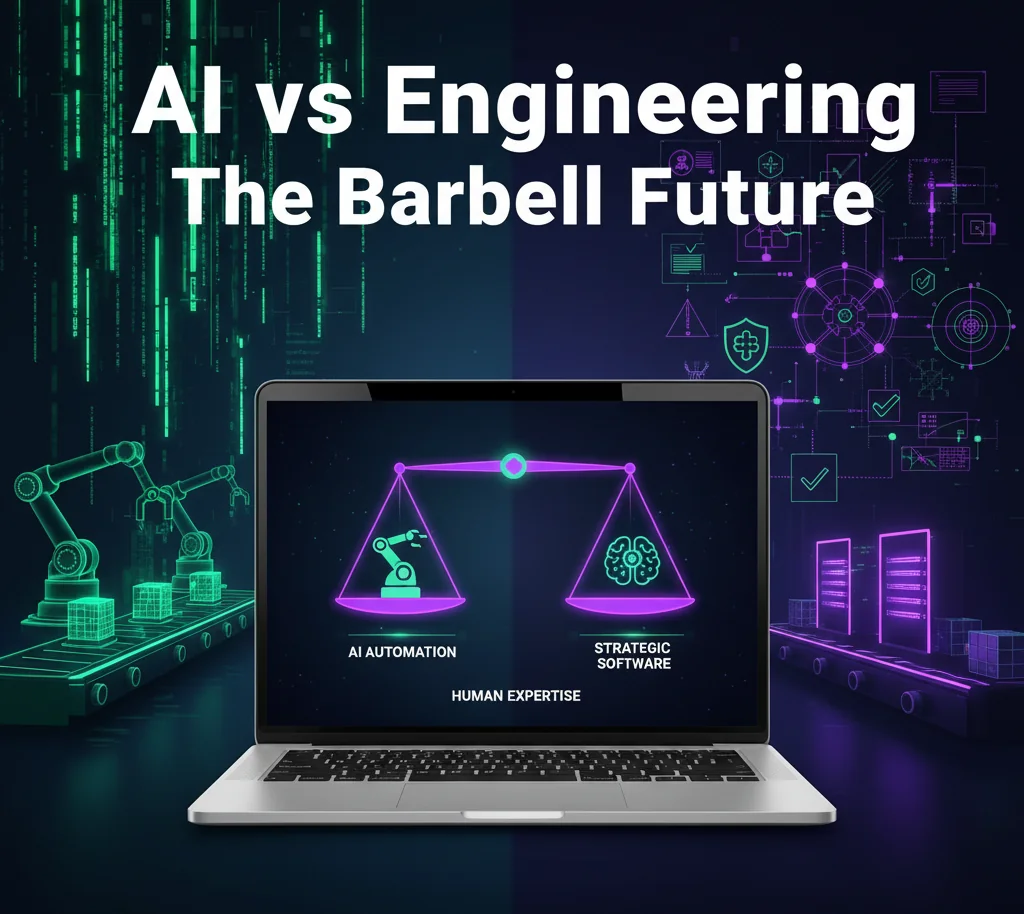
The software market is turning into a barbell. On one side is very cheap AI generated commodity code. On the other side is very high value custom, compliant or high performance engineering. The middle is shrinking.
- One end of the barbell: AI built commodity software such as CMSs, basic dashboards, CRMs and time tracking tools that can be recreated in weeks or days. These are now cheap and easy to copy.
- Other end of the barbell: high value systems for regulated, mission critical or performance sensitive use cases that still need expert engineers and architects.
- The squeezed middle: generalist project work that is not highly regulated, not deeply integrated and not very unique. This is exactly the space AI is eating first.
A Stanford linked study found that by mid 2025, employment for developers aged 22 to 25 had fallen almost 20 percent compared with late 2022, while older developers stayed stable or grew. This is the barbell effect in real numbers.
The Hidden Cost of AI Coding Tools
Developers feel faster with AI, but independent research shows a serious gap between perception and reality.
Speed vs quality
| Metric | AI perception | Real world impact (research) |
|---|---|---|
| Coding speed | Feels about 10–20 percent faster to engineers | A controlled study found tasks took about 19 percent longer with AI assistance. |
| Maintenance | Code appears instant to generate | 45.2 percent of developers say debugging AI code takes longer than human code. |
| Code health | Higher output volume feels productive | More copy and paste, more rework and rising technical debt in real projects. |
A 2025 study on experienced open source developers found that participants expected AI to make them faster but actually finished tasks 19 percent slower when using AI tools. Even after the slowdown, they still believed they had worked faster, which shows how strong the perception bias is.
At the same time, 45.2 percent of developers report that debugging AI generated code takes longer than fixing human written code. This is why teams often see more code flowing into review and less genuine progress in production.
For stronger expertise and trust, link this section to a readable summary of the METR study, such as the InfoWorld article on AI coding tools slowing developers by 19 percent.
The Junior Pipeline Problem
The sharpest pain is at the entry level. The Stanford payroll analysis showed that developers aged 22 to 25 saw about a 20 percent drop in employment after generative AI tools went mainstream, while developers over 26 did not see the same fall.
These junior roles existed mainly to do routine work such as CRUD endpoints, simple front end changes and basic integrations, which AI can now handle in many cases.
To avoid breaking the talent pipeline, companies need to redesign junior roles instead of removing them. A practical shift is to move juniors into AI orchestration and code auditing roles. They can learn by:
- Writing prompts and specifications that drive AI tools correctly.
- Reviewing and testing AI generated code for correctness, security and maintainability.
- Pairing with seniors on architecture and design while using AI to explore implementation options.
Understanding how autonomous AI agents like OpenClaw work in practice gives junior developers hands-on insight into the systems they will be auditing and orchestrating. This keeps a path into the profession while aligning junior work with the new reality of AI assisted delivery.
Where Non Replicable Value Now Lives
AI makes standard software cheap, but it cannot easily copy systems that are tied to unique constraints, data and workflows. The defensible 20 percent of software sits in a few clear areas.
- Deep domain expertise: systems that encode complex rules for healthcare, finance, government or industry specific regulations need teams that understand those domains in detail. For Australian organisations, understanding CPS 230 compliance requirements is a prime example of domain knowledge that AI cannot replicate.
- Proprietary data: products that improve over time using private, messy, organisation specific data are very hard for competitors to reproduce.
- Workflow ownership: software that becomes the main place where users spend their working day and connects into many other systems is far stickier than a simple single function tool.
- Custom business logic: when your real advantage is a unique way of pricing, routing, serving or measuring, the code that implements that logic is a core asset, not a commodity.
- Extreme performance optimisation: real time analytics, trading or embedded systems that push strict limits on latency and throughput still demand expert optimisation that generic AI solutions do not deliver.
These are the areas where software engineers increase business value rather than simply producing more code.
The Barbell Job Market
Employment is now following the same barbell pattern as the software itself. On one side, most routine coding tasks are automated or heavily augmented by AI tools, so there is less need to hire large teams to build commodity features.
On the other side, there is strong demand for senior engineers, architects and domain experts who can design, integrate and govern complex systems where the risk and value are both high.
For leaders, the key moves are:
- Stop funding custom builds for software that the market now treats as a commodity. Use AI, platforms and templates instead.
- Focus your best engineers on the 20 percent of systems that are truly strategic, such as core platforms, regulated workflows and data driven products.
- Redesign junior roles around AI orchestration, code auditing and observability so that the next generation of talent still builds real skills.
Key Takeaways for Tech Leaders
- The 80/20 rule: about 80 percent of existing software is convenience code such as CMSs and dashboards that AI and templates can now build cheaply.
- The junior gap: entry level developer roles fell around 20 percent after 2022 because their main output, routine logic and UI work, is now AI automated.
- The productivity paradox: developers feel faster with AI, but controlled trials show they can be about 19 percent slower once debugging and review are included.
- Build for moats: real value has shifted to proprietary data, regulatory compliance, deep system integration and performance sensitive systems that AI cannot cheaply copy.
Ready to build defensible software that AI cannot commoditise? At Hrishi Digital Solutions, our team specialises in architecting custom systems where differentiation, compliance and performance really matter.
Whether you need to modernise legacy platforms, design AI enhanced workflows or reduce risk in complex enterprise stacks, we help you decide which parts of your software should be automated and which must be treated as strategic assets. Our enterprise web application development services focus on building systems where differentiation truly matters.
Contact our team to discuss how to position your engineering function for the barbell era of AI, where routine code is cheap but true expertise has never been more valuable.
Hrishi Digital Solutions
Expert digital solutions provider specializing in modern web development, cloud architecture, and digital transformation.
Contact Us →